From:
Extensive Media Enterprises Good Monday morning. Breaking late Sunday afternoon — “Florida State fires Mike Norvell one day after Clemson loss” via Matt Baker of The Athletic — Florida State fired football coach Norvell Sunday following a 36-24 home loss to Clemson that dropped the Seminoles to 3-5. The dismissal ends a turbulent 41-39 tenure and triggers an approximately $50 million buyout, the third largest in college football history. Offensive analyst Rick Stockstill will serve as interim coach while FSU conducts a national search. Norvell led the Seminoles to a 13-0 regular season in 2023 before a stunning collapse, including a 2-10 campaign in 2024 and a 5-7 finish in 2025. President Richard McCullough acknowledged fans’ expectations. The firing comes amid major stadium investments, financial pressures, and uncertainty over FSU’s future conference affiliation. 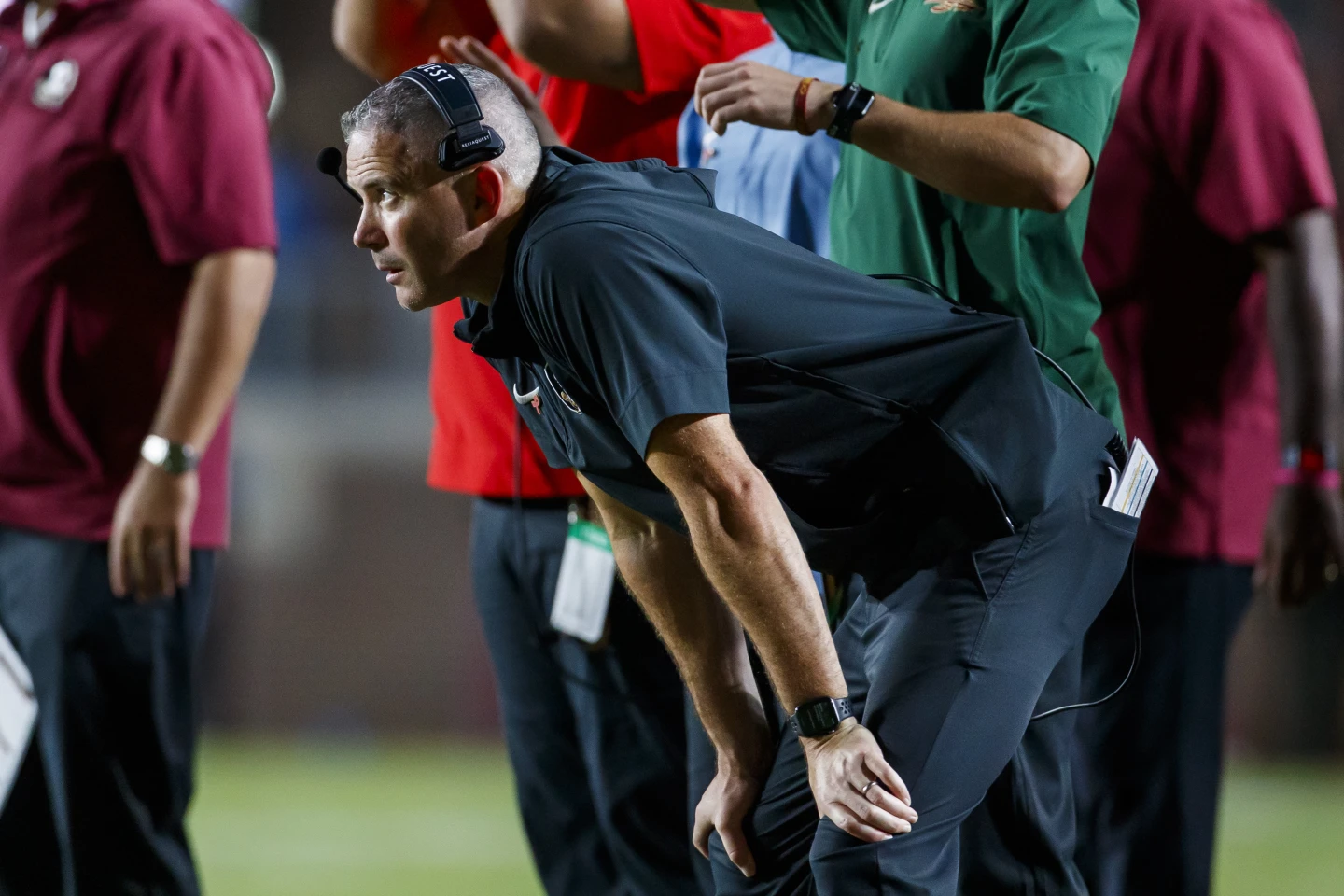
Mike Norvell exits Florida State after a turbulent tenure. Image via AP. ___ Here are some of the columns and stories I am reading the day before the election. 🔥 — A record for attention. Gallup finds 56% of U.S. adults have given "quite a lot" of thought to the election — the highest reading so far in a Midterm. The prior highs were 2018, 2010, and 1994, and each produced large seat swings. Fifty-six percent of registered voters are more enthusiastic than usual about voting, second only to 2018. Democrats lead on enthusiasm (58% to 48%) and on plans to vote early (54% to 38%). Among adults 65 and older, 73% have thought a lot about the election; among those under 30, 32%. Read Jeffrey Jones at Gallup. 🗳️ — Nobody deserves re-election. Gallup's final pre-Midterm poll puts support for re-electing one's own House member at 43%, the first time it has fallen under half in readings dating to 1994. Fifteen percent would re-elect most of Congress. Congressional approval is 14%, the lowest pre-Midterm mark since 1974. Republicans are more likely to keep their own members (51%) than Democrats (45%) or independents (36%). In all nine Midterms with congressional approval under 30%, the President's party lost House seats, and the size of the loss tracked the size of the majority it held going in. Read Megan Brenan's analysis at Gallup. 📊 — 2006 and 2018, side by side. Bruce Mehlman compares 2026 with the last two Midterms under a Republican President. Like 2006, it has an unpopular war (69% say Iran was not worth it) and a President at 38% approval. Gas is up 41% from a year ago. Consumer confidence is 91.7, against 105.4 in 2006 and 137.9 in 2018. The House battlefield: 42 competitive GOP seats, against 55 and 75. The Democratic Party is 11 points underwater on net favorability (+14 in 2006, -8 in 2018), and only two Democratic Senate seats are up in states the President carried, down from 10 in 2018. Democrats need three House seats and four Senate seats. See the full chart in Bruce Mehlman's Six-Chart Sunday. 🦄 — Cook on the unicorn election. Charlie Cook writes that this year's decisive voters are typically reliable rural Republicans, not independents or suburban swing voters, and that they are angry over the Iran attack, tariffs, and immigration enforcement. President Donald Trump's approval among Republicans is about 80%, down from 86% in January, and Cook calls it unenthusiastic. Those voters could vote Republican, stay home, leave races blank, or defect, and pollsters can't tell which. Cook's post-election questions are whether the Democratic House majority reaches 235 seats and whether Democrats get a five-seat Senate majority that doesn't depend on John Fetterman. He warns Democrats off the generic ballot because the deciding districts are redder than the country, and calls the result less a blue wave than a red undertow. Read Charlie Cook's column. 🎯 — 52 Democratic Senate seats, if the polls hold. Patrick Ruffini lined up polling averages, four models, and two prediction markets for the Senate battlegrounds. Democrats lead every average and every model in nine races, which, with 34 seats not up and nine safe seats, gets them to 52. The path runs through two states the President carried by 10 or more, most likely Alaska and Texas. A Midwest polling miss like 2016 would hit Michigan, Ohio, Iowa, and Kansas, the states that decide control. His early-vote tracker shows a much bluer electorate than in 2024, in line with 2018. Florida is the last row: Ashley Moody leads Angie Nixon by about six points in every average, and Kalshi and Polymarket price her at 90%. Read Patrick Ruffini at The Intersection. ⚖️ — Which way the polls could be wrong. G. Elliott Morris charted every source of polling error he tested this cycle. Pointing to polls that flatter Democrats: too few of the President's rural voters, discouraged Republicans skipping surveys, undecideds coming home, and low-effort respondents who lean Republican. Pointing the other way: voters who no longer admit backing the President in 2024, party weights frozen at 2024 levels, and undecideds breaking against the party in power. Most of the effects are a point or less. The typical final miss in Senate averages is about three points. Polls underestimated Republicans in 2016, 2020, and 2024 and Democrats in 2022, Virginia, and New Jersey. Morris offers no prediction on direction. See the chart at Strength In Numbers. ⏰ — Florida closes first. Bruce Mehlman sorted Tuesday's House and Senate races by poll-closing time into four outcomes: red riptide, blue tide (Democrats win 218 to 229 House seats), blue wave (230 to 239), and blue tsunami (240 or more). Florida's 7 p.m. close makes it the first test. House: Kathy Castor, Jared Moskowitz, and the open seat in Florida's 22nd Congressional District are a tide; Darren Soto and the open CD 7 seat are a wave; Republicans sweeping the four redrawn seats is a riptide. Senate: Moody by 10 or more is a riptide, four to nine a tide, three or less a wave. Also on his list: the Senate race uncalled at 9 p.m. is a good Democratic night; the Governor's race uncalled at 10 p.m. is a very good one. See both charts in Bruce Mehlman's Six-Chart Sunday. ___ Democratic strategist Steve Schale says Republicans ended early voting with an edge of about 130,000 ballots, just under 3 points, among the nearly 5.4 million who have voted. In a Sunday Substack post, the Democratic strategist wrote that Democratic turnout is approaching 49%, Republican turnout is 38%, and NPA voters make up 22% of the electorate so far. 
Florida voters head toward Election Day with turnout numbers keeping both parties guessing. For two years, Schale has said a Democrat can win statewide only if Democratic turnout exceeds Republican turnout, NPA voters favor Democrats by about 20 points, and more Republicans vote Democratic than the reverse. He writes that the first condition is in place and the NPA pool "looks" more Democratic based on where those voters are casting ballots. Whether Republicans cross over will be known only after Tuesday. Republicans still have about 700,000 more voters who cast ballots in 2020, 2022, and 2024. They won Election Day turnout by about 600,000 in 2022. Schale expects the final Republican edge to exceed 7.5 points. Most polls estimate 12 to 14. Pollster Tom Eldon has said R+9 for a year. Schale will not predict a result. "It is very much a race," he concludes. ___ St. Pete Polls has former Gov. Charlie Crist ahead of incumbent Ken Welch 55% to 35% in the final survey of the St. Petersburg Mayor’s race, and most of the city has already voted. Six in 10 likely voters say they have cast a ballot. Crist leads them 59% to 38%. Among the four in 10 still planning to vote, Crist leads 49% to 29%, with 22% undecided. 
Charlie Crist holds a commanding polling lead over Ken Welch in St. Petersburg’s Mayoral contest. Asked whom they support, 54% pick Crist and 34% pick Welch, with 12% undecided. Add in leaners and Crist rises to 55%, Welch to 35%, and the undecided pool shrinks to 10%. Give Welch every undecided voter, and he finishes at 45%. This is the fourth St. Pete Polls survey since the Primary, and Crist has held a majority in all four: 52% in September, 53% on debate day, 54% last week, and 55% now. Welch has gone 27%, 32%, 34%, and 35%. Both men are Democrats. Crist leads among Democrats 49% to 45%, Republicans 62% to 22%, and independents 58% to 31%. Black voters, who gave Welch a 55% to 16% lead in March, go to Crist 46% to 43%. Crist wins every age group and leads men 58% to 32% and women 53% to 37%. ___ The ads are cut. The slots are bought. The mail is in the box. All that’s left is to celebrate, win or lose, the hard-fought battles that brought us to one of the most consequential Election Days of our generation. That means we need to hear from you. Where will you watch the results roll in on Election Night? Who will be joining you? Are you welcoming the public, or celebrating in private with friends and family? Send your info to Peter@FloridaPolitics.com, and best of luck to everyone! |


No comments:
Post a Comment
Note: Only a member of this blog may post a comment.